 DKT
Key points on more road rules for the Victoria learner test. Each answer is checked against the official Victoria handbook or road rules; use the practice-question links to test yourself.
You approach a crossing and see the scene in the picture. What should you do?
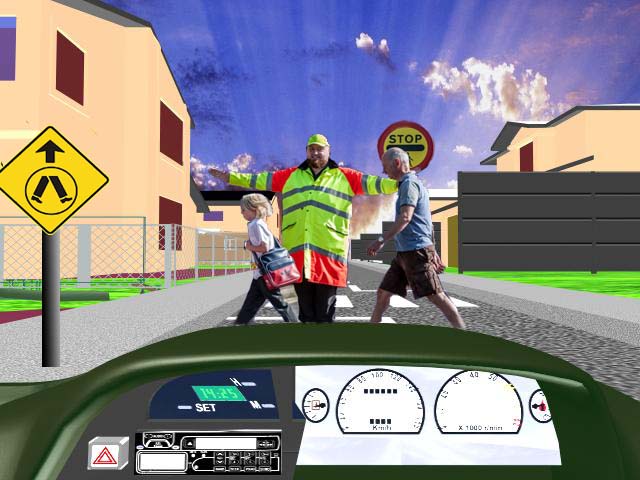
Answer: Slow down and stop until the supervisor lowers the sign
Stop and stay stopped until all pedestrians have left the crossing and the supervisor is no longer showing the STOP sign.
Practice question 123 · official source
On most 50 km/h roads outside Victorian schools, when does the 40 km/h limit apply?
Answer: At all times, it is a permanent limit
Outside most Victorian schools on 50 km/h roads the 40 km/h limit is permanent. Time-based 40 km/h limits apply on 60 and 70 km/h roads.
You are driving in a shared zone with pedestrians walking about. Who must you give way to?
Answer: Any pedestrian in the zone
In a shared zone, pedestrians may use the road, and a driver must give way to any pedestrian in the zone.
Practice question 125 · official source
You are going straight at a crossroads with no sign on your road. A vehicle on your right faces a give way sign. Must you give way to it?
Answer: No, it must give way to you, but stay alert in case it does not
The give way to the right rule does not apply when a stop or give way sign or line applies to the other driver. Even so, be ready to avoid a collision.
Practice question 131 · official source
How does a stop sign differ from a give way sign in what you must do?
Answer: A stop sign needs a full stop; give way needs a stop only if needed
Give way at a stop sign means remaining stationary until safe. At a give way sign it means slowing down and stopping only if needed to avoid a collision.
Practice question 135 · official source
A stop sign has a white stop line across your lane. Where must you stop your vehicle?
Answer: As close as is practical to the line, but before reaching it
You must stop as near as practicable to, but before reaching, the stop line. Stopping past it blocks the view and the path of other road users.
Practice question 136 · official source
At traffic lights you see a flashing yellow right-turn arrow. What must you do if you want to turn right?

Answer: Turn right only when clear, giving way to oncoming vehicles and pedestrians
A flashing yellow arrow lets you turn in that direction but you must give way to vehicles on the road you are entering, oncoming traffic when turning right, and pedestrians.
Practice question 146 · official source
You are turning right on a green right-turn arrow. Must you give way to oncoming vehicles?
Answer: No, but you must still give way to pedestrians crossing
On a green turn arrow you need not give way to oncoming vehicles, but you must still give way to pedestrians crossing the road you are entering.
Practice question 147 · official source
A police officer is directing traffic at an intersection. What must you do?
Answer: Follow their hand signals and directions
If police or a traffic controller are at an intersection, you must follow their hand signals and directions.
Practice question 148 · official source
You approach an intersection controlled by a traffic controller. What must you do?
Answer: Follow the traffic controller's directions
If police or a traffic controller are at an intersection, you must follow their hand signals and directions.