 DKT
Key points on more safe driving for the Northern Territory learner test. Each answer is checked against the official Northern Territory handbook or road rules; use the practice-question links to test yourself.
What is the best way to check behind you before reversing?
Answer: Look behind directly as well as using your mirrors
Mirrors do not show everything. Turn and look directly behind the vehicle.
Practice question 426 · official source
Another driver fails to give way when you should have priority. What should you do?
Answer: Slow down or stop to avoid a crash, even if you had priority
Road rules say who must give way, but no one gets absolute right of way. Do not force a dangerous situation; avoid the crash first.
Practice question 427 · official source
Why should you leave some room beside parked cars when you drive past them?
Answer: A door might open or a person might step out
Leaving a buffer lets you avoid opening doors and people stepping out from between parked vehicles.
Practice question 428 · official source
You are the motorcyclist going straight ahead through this roundabout. Why should you watch the car marked A?
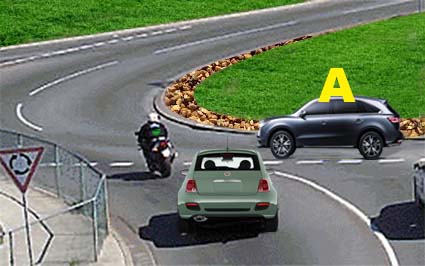
Answer: It may be about to leave the roundabout in front of you
Vehicles in a roundabout may leave at any exit, often with a late indicator. Give way to them and watch what they do before you enter.
Practice question 429 · official source
Your car starts to skid. What is the best first response?
Answer: Ease off the accelerator, avoid harsh braking, steer smoothly
Do not slam the brakes or make sudden steering movements. Ease off the accelerator, keep a firm grip and steer smoothly where you want to go.
Practice question 439 · official source
Another driver pulls into the gap in front of you and the gap is now much smaller. What should you do?
Answer: Ease off the accelerator and build a safe gap again
Rebuild your crash avoidance space by easing off. Tailgating in reply only raises your crash risk.
Practice question 440 · official source
Why is driving 5 km/h over the limit more dangerous than many people think?
Answer: Even small speed rises lengthen stopping distance and worsen crashes
Small increases in speed raise both the chance of a crash and how badly people are hurt.
Practice question 441 · official source
Why is travelling just 5 km/h over the speed limit risky when a hazard appears suddenly?
Answer: You need more distance to stop and hit with more force
Even a small increase in speed lengthens stopping distance, so an obstacle is hit at a much higher speed.
Practice question 442 · official source
A speed limit sign shows 100 km/h but it is pouring with rain. What is the best speed?
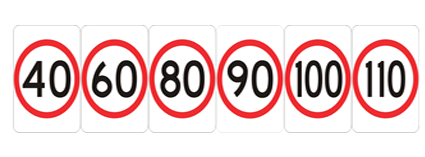
Answer: Slower than 100 km/h to suit the conditions
The speed limit is the maximum in ideal conditions. You must drive to the conditions, which may mean much slower.
Practice question 443 · official source
When your speed doubles, what happens to your braking distance?
Answer: It becomes about four times longer
Braking distance rises faster than speed. Doubling your speed makes the braking distance roughly four times as long.