 DKT
Key points on more road signs for the New Zealand learner test. Each answer is checked against the official New Zealand handbook or road rules; use the practice-question links to test yourself.
At this sign, who must you give way to?
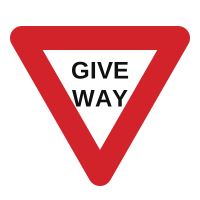
Answer: Approaching or crossing vehicles that face no Stop or Give Way sign
At a Give Way sign you give way to vehicles approaching or crossing that are not controlled by a Stop or Give Way sign.
Practice question 45 · official source
What must you do at this sign?

Answer: Stop where you can see the way is clear, then give way
At a Stop sign you must always stop, in a position that lets you see if the way is clear, and give way to vehicles not controlled by a Stop sign.
Practice question 60 · official source
A red diagonal cross is shown on an overhead sign above your lane. What does it mean?
Answer: The lane is closed to you, and you must not use it
A lane declared unavailable by an overhead sign with a red diagonal cross must not be used.
Practice question 46 · official source
A road worker holding a manually controlled stop sign faces you. What must you do?
Answer: Stop and wait for a Go or Slow sign or until it is withdrawn
You must stop before reaching a manually controlled stop sign and not go until the controller displays a go or slow sign or stops showing the sign.
Practice question 47 · official source
A broken yellow line runs along the road edge, no more than 1 m from it. What does it mean?
Answer: You must not stop, stand or park there
A broken yellow line parallel to and within 1 m of the roadway edge prohibits stopping, standing or parking.
Practice question 48 · official source
A parking restriction sign shows the symbol P and no other days or times. When does it apply?
Answer: Between 8 am and 6 pm on days other than public holidays
Signs with a P symbol (and loading zone signs) apply from 8 am to 6 pm except public holidays, unless another time is shown. Other parking signs apply at all hours.
Practice question 49 · official source
A school bus with its school bus sign displayed has stopped to pick up or drop off children. What is the maximum speed when passing it?
Answer: 20 km/h
When meeting or passing a school bus stopped to let children on or off, you must drive with care and no faster than 20 km/h, even on the opposite side of the road.
Practice question 56 · official source
A school patrol has put out a school patrol sign at a crossing as you approach. What must you do?
Answer: Stop before the crossing and stay stopped while the sign is out
You must stop before the crossing and remain stopped for as long as the school patrol sign is extended.
Practice question 57 · official source
You are approaching a sign that shows a lower speed limit. When should you reduce your speed?
Answer: Before you reach the sign
Slow down before you reach a sign showing a lower limit. You can speed up after passing a sign for a higher limit.
Practice question 58 · official source
A recommended (advisory) speed sign is shown before a bend. What should you do?
Answer: Slow down to suit the sign before you enter the bend
Look for the recommended speed sign and slow down before the curve for control. Braking in the curve reduces grip and stability.